





Fermenting Anti-Fascist Living is a collaborative, participatory research project exploring fermentation as an alchemical and political practice that breaks down dominant structures and nourishes relational, anti-fascist ways of living.
The research began online during the first iteration of SALT – Study Kitchen, and continued at BAK Basecamp from November 2025 to June 2026. With a cohort, we learned from microbial living systems how transformation unfolds. We asked how these processes might inform social movement strategy, collective organising and political practice under conditions of collapse and authoritarian drift.
The far right, white supremacy and militarisation are rising, and colonial violence continues. In this context, fermentation offers both a language and a practice for resisting otherwise. Through collective study, conversation and hands-on fermenting, we examined anti-fascist resistance through a decolonial lens. We drew lessons from fermentation's queer rhythms and more-than-human cooperation, and explored how these relational logics can help us build resilient, plural movements.
We approach fermentation is a counter-logic to fascist ideology:
Where fascism suppresses life, fermentation multiplies it.
Where fascism fears difference, fermentation thrives on it.
Where fascism clings to purity and rigid identity, fermentation cultivates symbiosis, contamination, interdependence and queer temporalities.
Please note: we do not suggest fermentation is a political tool in itself. Rather, we turn to our microbial companions as guides for fermenting resistance in the present.
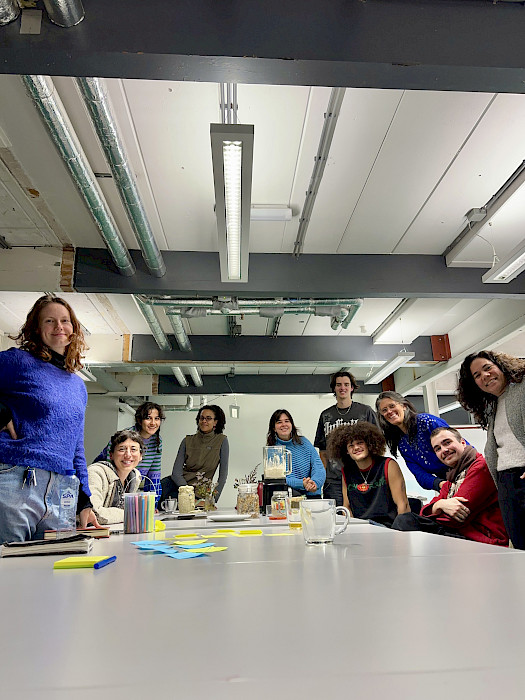
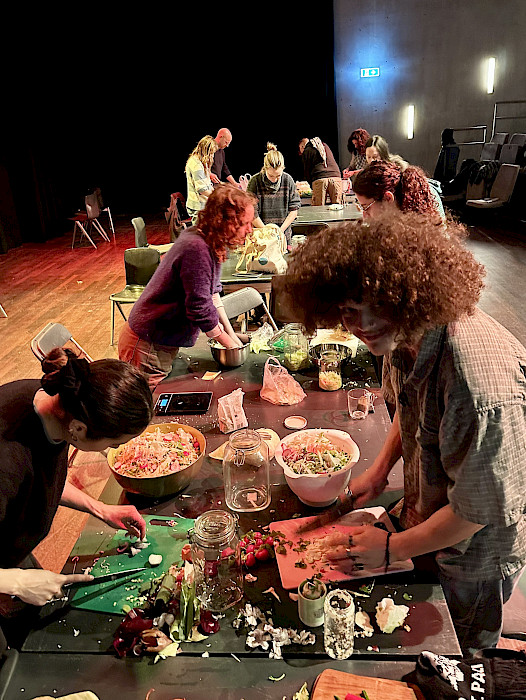
Speech written and delivered by Teresa Borasino at the Anti-Fascist Congress on 14 June 2026, at BAK Basecamp. Nancy Jouwe initiated the congress, which revived the spirit of the 1933 anti-fascist congress in Utrecht.
Microbial Resistance
For the last year, we've been fermenting antifascist practice with a group of people here in Basecamp. We've made vinegar, sauerkraut, dosas, and more ferments. We’ve been learning with microbes, specifically with bacteria and yeast. And asking a question that might sound strange in this room: what can these tiny, ancient, living processes teach us about fighting fascism?
I ask it as an artist and an ecological thinker, because I believe that to face this fascist turn — the accelerating violence of the far right and the ideologies of separation that make all of this violence possible — we need registers of thinking that the colonial framework can't give us. We need tools that do not come from the colonial repertoire – from the cultural archive as Gloria Wekker offered yesterday. We need to shift our vantage point. We need to consult the more-than-human world. And that means organising not only with each other, but with the microbes — in the soil, in our guts, in the jar on the table — not as metaphors, but as collaborators. As comrades.
Why fermentation?
Because fermentation runs on the opposite logic of fascism. Fascism is obsessed with purity, with sterility, with eliminating whoever and whatever doesn't belong. A ferment is wild — many organisms take part of transformative processes while none of them is in charge. While fascism fears difference; fermentation depends on it. The more diverse the culture, the more resilient and alive it is.
I want to share what fermentation has been teaching us.
Fermentation relies on contamination. contamination is one of the primary forces of evolution. Anna Tsing talks about this in her book the mushroom at the end of the world. That Contamination doesn't only come from gentle encounter, but also comes from violence. She calls it contaminated diversity — and she's clear that it is often ugly and humbling at the same time. This contaminated diversity emerged out of histories of conquest, slavery, dispossesion. It implicates survivors in the very histories that produced them. I feel this in my own body as someone carrying the lineage of the colonised and the coloniser at the same time, as I imagine many of us in this room do. Histories of survival and histories of the oppressor run through the body. Fermentation teaches us that this is not a problem to purify away. It is the ground we have to work from. For those of us shaped by colonial histories — and its present — survival has never meant walling yourself off from the other. Survival is the capacity to be transformed by the other.
The second lesson is about conditions. And its maybe the most important lesson. We spend so much of our movement energy on strategy and demand. But fermentation doesn't work by force. Fermentation tends the conditions: [salt, warmth, moist, light, keeping oxygen out]. Get the conditions right, and the culture does the work itself. And here's the part that matters the conditions that let beneficial cultures thrive are exactly the conditions in which pathogens cannot grow, and take hold. A healthy ferment doesn't fight off toxins by sterilising everything; it builds an environment where harm simply can't establish itself. So instead of only asking how we defeat the far right, we should be asking: what are the conditions necessary for our movements to thrive? How do we make livable, favorable conditions for each of us?
The third lesson is to compost to regenerate. Fermentation is inseparable from decay. It is actually rotting. When things go wrong in our movements — and they will, there will be conflict and harm and grief — the question is not so much how to prevent it. It's whether we have practices for metabolising it. Or whether we let it sit and turn toxic and eat us from the inside. Conflict and grief, composted well, becomes nourishment.
And one last thing. Ferments bubble. They fizz, they expand, they heat up. That liveliness — full of joy — is not a distraction from how serious this moment is. It's part of how transformation actually happens. Resistance has to be irresistible.